This page collects graphics from across the Indian Health Financing research, organized by topic. It begins with how the AI/AN population itself is counted and defined, then the methods used throughout the research, then moves through funding, need, the funding gap, Medicaid, Medicare and dual eligibility, and Purchased/Referred Care, closing with CRIHB’s historical contribution to CMS Tribal data work and a graphic on the IHCIA reauthorization. Each graphic includes a download link to the full-resolution image.
- Distribution of Tribes by Size
- How We Count AI/AN Population
- Key Definitions of AIAN Population with Estimates and Administrative Data
- Methods: How We Measure and Analyze Indian Health Financing
- Estimating Funding Equity
- User Need Estimates: Two Methods
- Indian Health System: Access Has Grown, But Capacity Has Not Kept Pace
- Medicaid Enrollment Trends for AI/AN People
- How Medicaid Works Differently in Indian Country
- Medicare and Medicaid: Enrollment Gains in Medicare and Dual Eligibles
- Medicare Among AI/AN People in the IHS-Access Population
- Dual Eligibles: Where Medicare and Medicaid Meet in Indian Health
- Purchased/Referred Care (PRC): Does Not Keep Up With Inflation
- CRIHB Contributions to CMS Tribal Data Improvement, 2007–2014
- Indian Health Care Improvement Act Reauthorization








1. Distribution of Tribes by Size
Tribal enrollment is highly concentrated among a relatively small number of large tribes. This graphic shows the distribution of federally recognized tribes by enrolled-citizen population and illustrates why aggregate measures of the American Indian population can obscure substantial differences among Tribal communities.
Related paper: Paper I — How We Count Matters

2. How We Count AI/AN Population
Different population definitions produce very different estimates of the American Indian and Alaska Native population. This graphic compares enrollment, Census, IHS, and other population measures and explains why the choice of population definition matters when measuring health needs, coverage, and Indian health financing.
Related paper: Paper I — How We Count Matters
3. Key Definitions of AIAN Population with Estimates and Administrative Data
This graphic lays out the key terms used to define and count the AI/AN population — showing how estimate-based figures (such as Census counts) differ from administrative figures (such as IHS user population or Tribal enrollment) — and pairs each definition with representative numbers. It serves as a quick reference for the population terms used throughout the site’s other graphics and papers.

Related papers: Paper I — How We Count Matters and Paper IV-F — AI/AN Health Coverage Trends (2020 Census artifact)

4. Methods: How We Measure and Analyze Indian Health Financing
This graphic summarizes the methodological framework used throughout the Indian Health Financing research. It brings together population data, Medicaid and Medicare enrollment, CMS and IHS administrative data, federal spending, health system measures, and other sources to examine how resources flow through the Indian health system and how financing relates to access and performance.
Related paper: Paper IV — CMS–IHS Data Match

5. Estimating Funding Equity
This graphic presents the broader Indian health financing picture by comparing current federal funding with estimated health care needs. It examines the relationship between IHS funding, population and utilization, projected requirements, and the resources needed to move toward greater funding equity.
Related paper: Paper V — The Full-Funding Requirement

6. User Need Estimates: Two Methods
This graphic compares two methods for estimating health care need among AI/AN people. The comparison demonstrates how population definitions and methodological choices affect estimates of need and, ultimately, estimates of the resources required to achieve health equity.
Related paper: Paper V — The Full-Funding Requirement

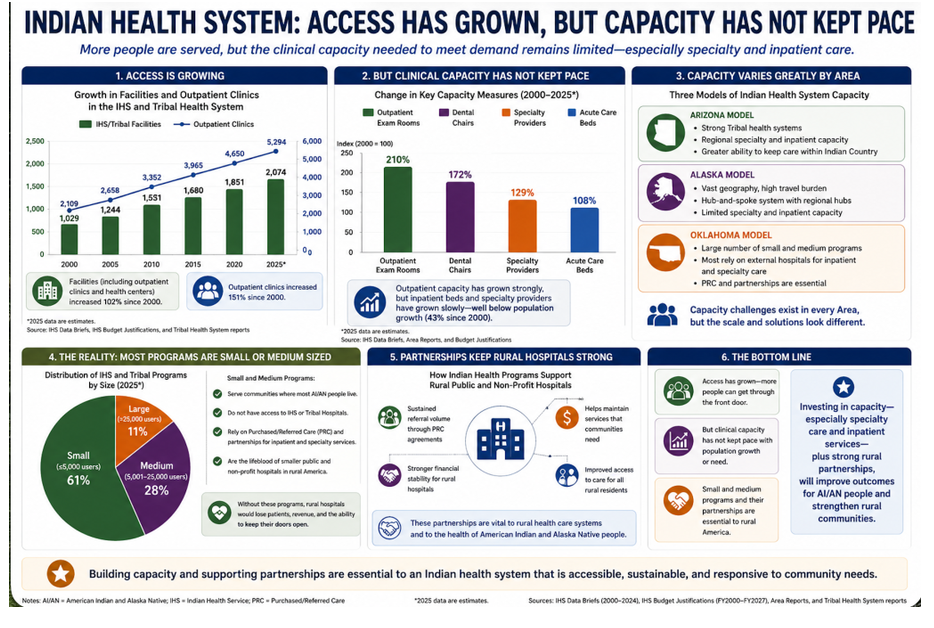
7. Indian Health System: Access Has Grown, But Capacity Has Not Kept Pace
The Indian health system has expanded access through increased facilities, services, Medicaid coverage, and other investments. However, growth in demand and enrollment has often outpaced the system’s capacity to provide care. This graphic examines that gap and highlights the continuing need for investments in facilities, workforce, infrastructure, and sustainable health financing.
Related paper: Paper IV-D — Expanding Access to Care: Facility Growth and Population Change

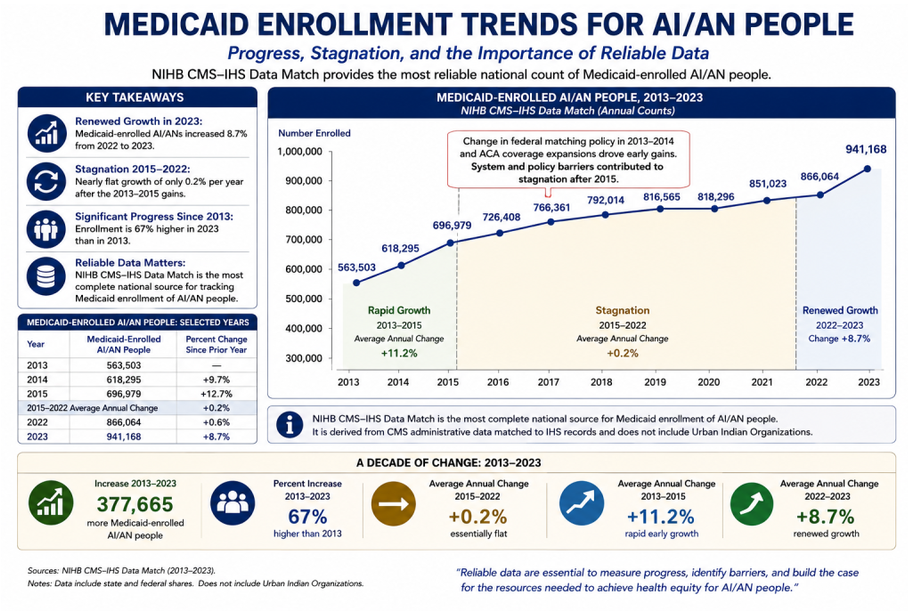
8. Medicaid Enrollment Trends for AI/AN People
This graphic traces Medicaid enrollment among American Indian and Alaska Native people from 2013 through 2023. It documents substantial enrollment growth and changes in Medicaid coverage while highlighting the importance of reliable population and enrollment data for understanding Medicaid’s role in Indian health financing.
Related papers: Paper IV — CMS–IHS Data Match and Paper IV-B — The Affordable Care Act and AI/AN Populations

9. How Medicaid Works Differently in Indian Country
Medicaid plays a distinctive role in Indian Country because American Indian and Alaska Native people may receive care through IHS, Tribal health programs, Medicaid, or combinations of these systems. This graphic explains how Medicaid financing, eligibility, federal policy, and Tribal health systems interact—and why Medicaid is an important component of Indian health financing.
Related paper: Paper III — The Effective FMAP Subsidy

10. Medicare and Medicaid: Enrollment Gains in Medicare and Dual Eligibles
This graphic moves from overall enrollment to the intersection of Medicare and Medicaid. It examines the growth of Medicare enrollment and the increasing number of AI/AN people who qualify for both programs.
Related paper: Paper IV-C — Medicare Enrollment Among AI/ANs, 2014–2024

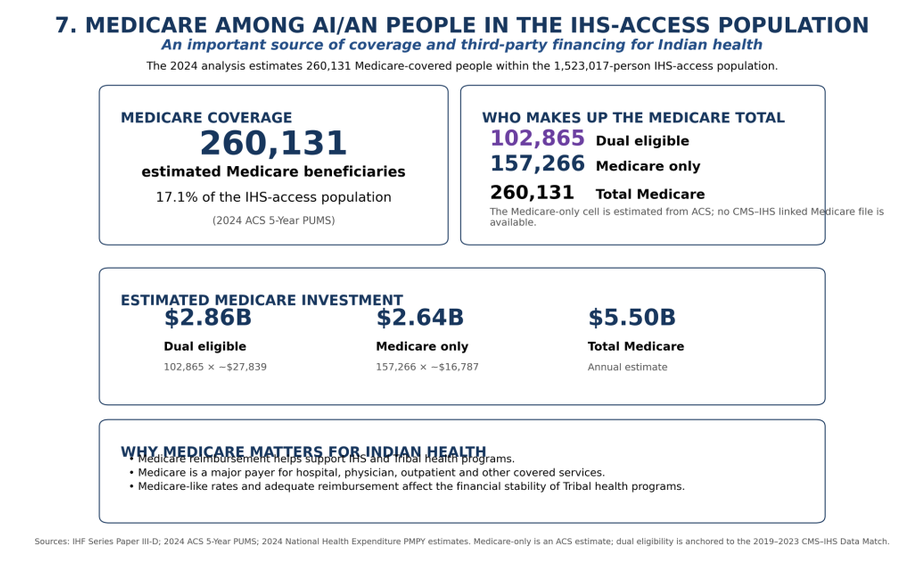
11. Medicare Among AI/AN People in the IHS-Access Population
This analysis quantifies the Medicare population within the IHS-access population and estimates associated Medicare spending. It demonstrates that Medicare represents a substantial source of health care financing alongside IHS and Tribal resources.
Related paper: Paper IV-C — Medicare Enrollment Among AI/ANs, 2014–2024

12. Dual Eligibles: Where Medicare and Medicaid Meet in Indian Health
Dual-eligible AI/AN people qualify for both Medicare and Medicaid and represent an important part of the IHS-access population. This analysis examines their numbers, coverage, and associated spending, showing how the two programs together contribute substantial resources to Indian health care.
Related papers: Paper IV-G — Dual Medicare–Medicaid Coverage Among AIAN Populations and Paper IV-H — Dual Eligibles, Tribal Health Systems, and 100% FMAP

13. Purchased/Referred Care (PRC): Does Not Keep Up With Inflation
Purchased/Referred Care is a critical component of the Indian health system, providing access to services that cannot be delivered directly by IHS or Tribal facilities. This analysis compares PRC funding with the growth in health care costs and demonstrates the widening gap between available resources and the cost of purchased care over time.
Related paper: Paper IV — CMS–IHS Data Match (PRC financing interaction)
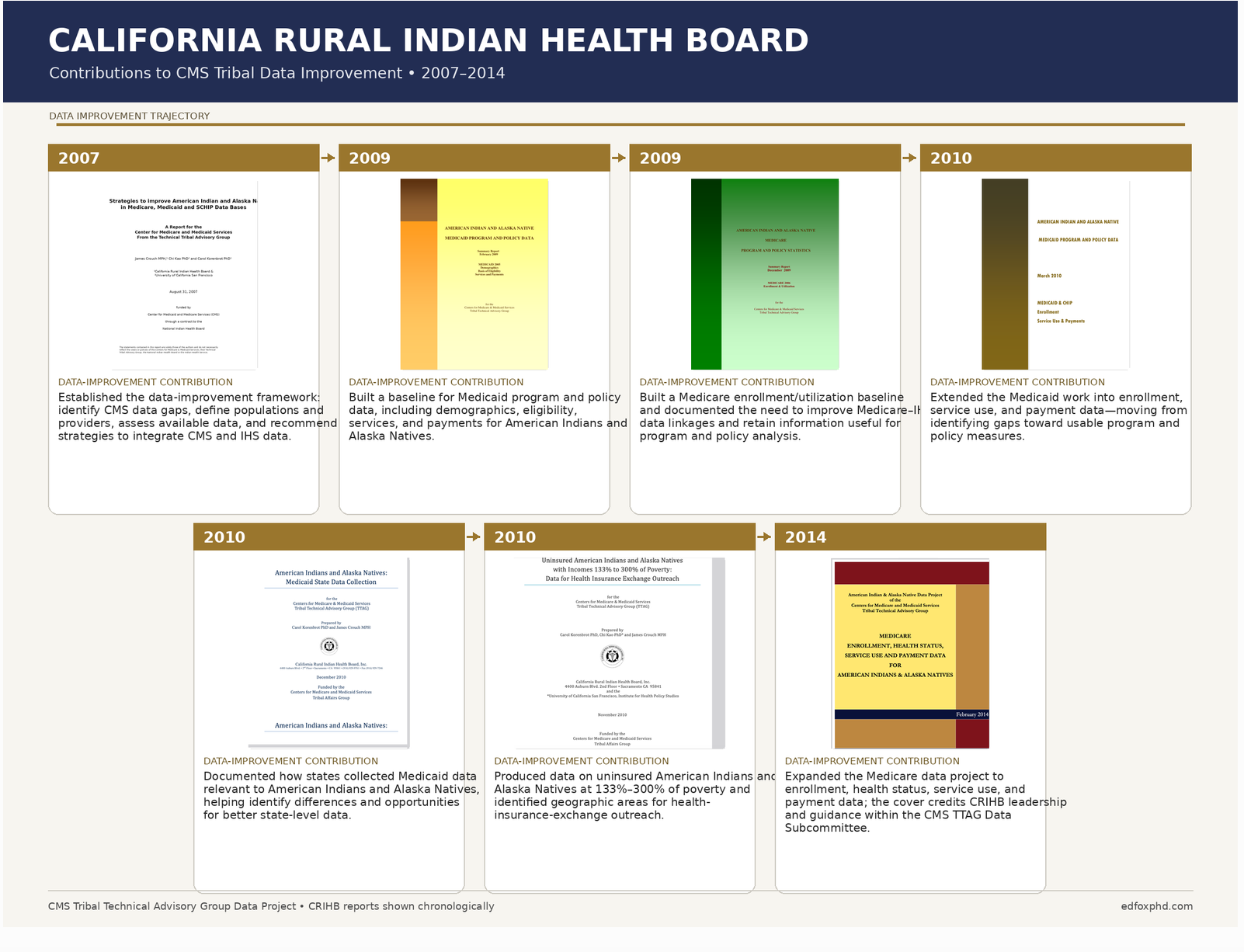
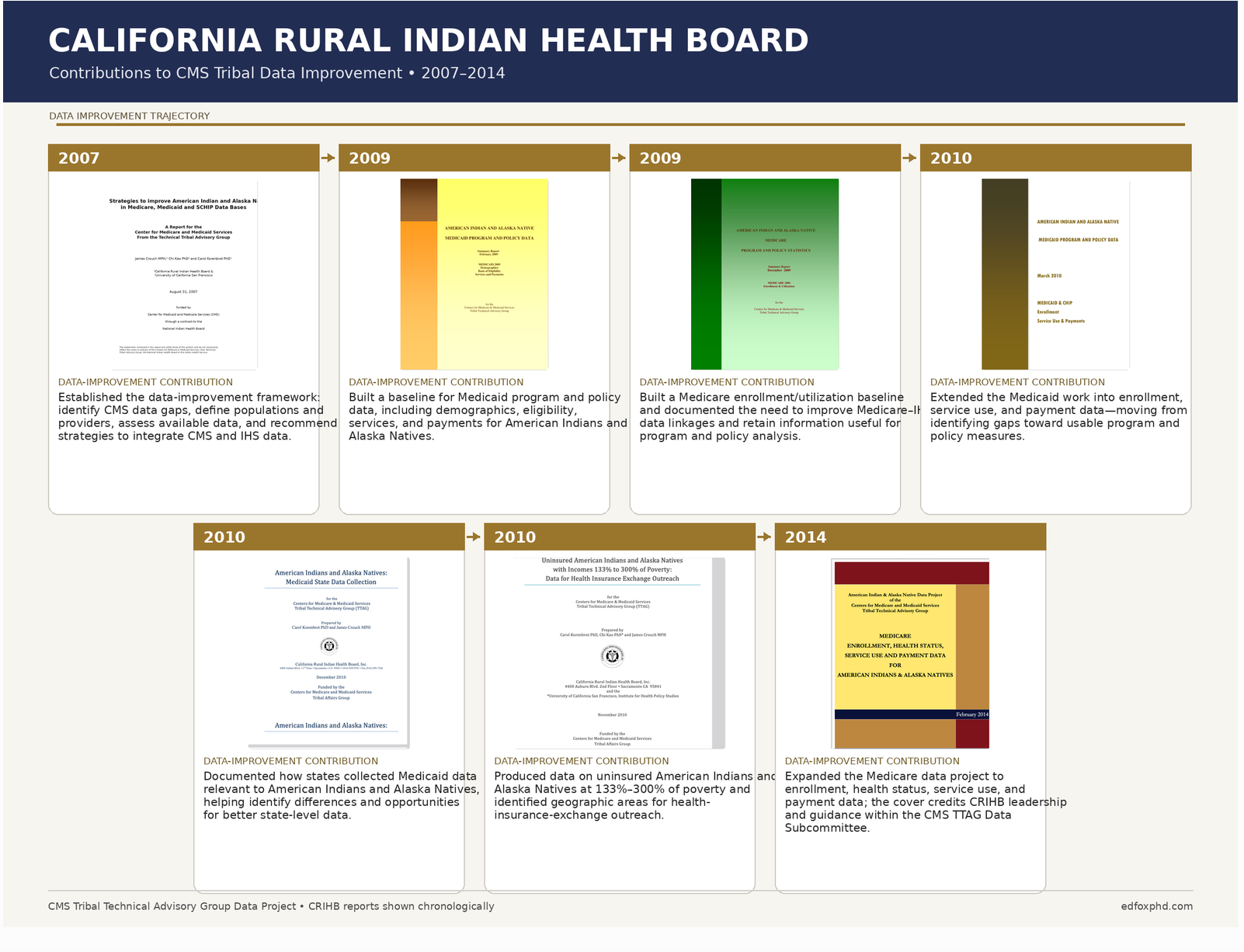
14. CRIHB Contributions to CMS Tribal Data Improvement, 2007–2014

This graphic highlights the California Rural Indian Health Board’s contributions to the CMS Tribal Technical Advisory Group Data Project from 2007 through 2014, using the covers of the reports produced during this period.
Related paper: Paper II — A History of CMS–IHS Tribal Data Improvement
15. Reauthorization of the Indian Health Care Improvement Act
This graphic set traces the reauthorization of the Indian Health Care Improvement Act, focusing on the drafting of Title IV during the critical 1999–2000 period, and identifies the institutions and individuals involved in that process.


Related paper: Paper I-B — The Reauthorization of the Indian Health Care Improvement Act: The Critical Year 1999–2000