Choose how to read:
Read the Full Publications Collection | Browse Papers by Short Introduction
Indian Health Finance Research and Publications
Full Bibliography
This is the primary collection of my research and publications on Indian health policy, financing, data, and the history of tribal health programs.
Indian Health Financing Series
Core research papers, the Access & Coverage sub-series, supporting supplements, and the Urban Indian Health extension
Indian Health Finance Research Series
The Indian Health Finance Research Series examines how the federal government finances health care for American Indians and Alaska Natives, how those financing mechanisms developed, and the gap between current federal investment and the resources required for comprehensive care.
The Indian Health Financing Series consists of five principal papers, an Access & Coverage sub-series built around Paper IV, supporting supplements, and a separate Urban Indian Health extension. Together, the papers trace the development of Indian health financing, examine the structural role of Medicaid and other federal programs, and develop an estimate of the funding required to provide a full spectrum of health care to populations eligible for Indian Health Programs.
Together, the papers provide a framework for understanding Indian health financing not as a collection of separate programs, but as an interconnected federal financing system.
Note on AI-Assisted Development
The papers in this series were developed with the assistance of artificial intelligence tools. AI was used to support research organization, drafting, editing, data analysis, and document preparation. The author directed the research, supplied source materials and substantive judgments, reviewed and edited the resulting work, and is responsible for the final content and conclusions. That is, if any hallucinations, flowery language, or contrived logical symmetry remain they are the sole responsibility of the author. Human agency has to prevail.
AI generated from Edfoxphd.com only information
An AI-assisted analysis of ACS-reported IHS access and health coverage, prepared exclusively from research, tables, and methodological notes published on this site.
Read the analysis: IHS Access and Health Coverage · PDF · Word
Recent Updates
- Paper V — The Full-Funding Requirement — revised PDF posted October 13, 2026, with an addendum comparing the paper’s estimate with the National Tribal Budget Formulation Workgroup’s
- Paper IV-F — AI/AN Health Coverage Trends, 2010–2024 — revised PDF posted October 12, 2026, with two companion papers on the 2020 race question and a new Data Tables page
- The American Community Survey and Indian Country: What Is at Stake in the 2030 Census Debate? — on the Census Bureau’s proposal to drop race and ethnicity questions from the 2030 short form; public comments due October 13, 2026, and from Tribal Nations and Tribal-serving organizations by November 2, 2026
- Paper II — A History of CMS–IHS Tribal Data Improvement — revised PDF posted September 8, 2026
- Paper IV — CMS–IHS Data Match — revised PDF posted September 1, 2026
- “Making Indian Health Financing Policy” (formerly “How Many Signatures?”) — added September 2, 2026; revised and retitled October 2026
- Paper III — The Effective FMAP Subsidy — paper download link fixed August 23, 2026
Core Series
Paper I — How We Count Matters
Tribal Enrollment, Census Identity, and the Mismeasurement of American Indian Populations
Short abstract
This paper argues that IHS access — not Census race/ethnicity counts or Tribal enrollment figures — is the most operationally useful denominator for measuring the population that federal Indian health financing actually needs to serve, and that relying on the wrong denominator systematically distorts funding-adequacy comparisons.
Federal and state policies affecting American Indian and Alaska Native populations often conflate Tribal citizenship with Census self-identification, even though these measures represent different populations. This paper examines the differences among Census identity, Tribal enrollment, homeland residence, and the broader Tribal community. It argues that the IHS-access population—approximately 1.3 million people reporting access to IHS-funded services—provides the most operationally useful denominator for analyzing federal Indian health financing.
Related graphics: Distribution of Tribes by Size, How We Count AI/AN Population, Key Definitions of AI/AN Population with Estimates and Administrative Data, and Methods: How We Measure and Analyze Indian Health Financing
Paper I-B — The Reauthorization of the Indian Health Care Improvement Act: The Critical Year 1999–2000
Short abstract
This paper argues that the 1999–2000 Indian Health Care Improvement Act reauthorization process demonstrated Tribal nations’ capacity to collectively develop sophisticated federal legislative proposals, and that the resulting statutory provisions — despite delayed congressional passage until 2010 — became foundational to the financing mechanisms examined later in this series.
This paper examines the 1999–2000 Tribal consultation and drafting process that produced a consensus proposal to reauthorize the Indian Health Care Improvement Act. Led through a National Steering Committee and extensive regional Tribal consultation, the process demonstrated the capacity of Tribal nations to collectively develop sophisticated federal legislative proposals.
Related graphic: Reauthorization of the Indian Health Care Improvement Act. Companion essays: IHCIA Reauthorization: History and Participants
Paper II — A History of CMS–IHS Tribal Data Improvement New/Revised — Sep 8, 2026
The Role of the CMS Tribal Technical Advisory Group
Short abstract
Federal administrative data have historically provided incomplete and sometimes inaccurate information about American Indian and Alaska Native participation in Medicare and Medicaid. This paper traces the role of the CMS Tribal Technical Advisory Group (TTAG) in improving the identification and analysis of AI/AN beneficiaries in federal health data.
It focuses particularly on the work of the TTAG Data Committee and the development of improved data-matching methods. The March 2024 CMS–IHS Data Match Results provided an initial 2019 match, while the October 2025 CMS/IHS Data Match Report expanded the analysis to a five-year 2019–2023 series. The resulting data match is examined in detail in Paper IV, which analyzes its enrollment, expenditure, geographic, and fiscal implications.
Related graphic: CRIHB Contributions to CMS Tribal Data Improvement, 2007–2014
Historical source documents: CRIHB and CMS Tribal Data Improvement, 2007–2014 — chronological links to the original CRIHB reports behind Paper II.
Paper III — The Effective FMAP Subsidy New/Revised — Aug 23, 2026
The Effective FMAP Subsidy: How Tribal and IHS Facilities Increase the Federal Share of Medicaid
Short abstract
This paper argues that the 100% FMAP for Tribal- and IHS-delivered Medicaid services functions as a substantial, underused fiscal mechanism — one that increases the federal share of state Medicaid spending in the eight states studied, but is constrained by administrative and policy barriers that limit states from fully using it.
Federal law provides 100% FMAP for qualifying Medicaid services delivered through Tribal health programs and Indian Health Service facilities, eliminating the state share for those services. This paper examines the fiscal implications of that provision across eight states with large American Indian and Alaska Native populations. It introduces the concept of “effective FMAP” and shows how Tribal and IHS health systems can substantially increase the federal share of a state’s Medicaid spending, while identifying administrative and policy barriers that limit states’ use of this financing mechanism.
Related graphic: How Medicaid Works Differently in Indian Country
For the conceptual distinction between the encounter rate and FMAP that underlies this estimate, see the companion piece, “The IHS-OMB Rate and FMAP: An Underappreciated Driver of Indian Health Program Medicaid Financing.”
Paper IV — CMS–IHS Data Match New/Revised — Sep 1, 2026
Anchor paper for the IHS Access & Coverage sub-series
Title: Medicaid and IHS Access: The Fiscal Magnitude and Structural Role of the CMS–IHS Data Match
Byline: Edward J. Fox, PhD
Data match analysis: Rochelle Ruffer, PhD, and Jeannie Le, National Indian Health Board; technical development by the CMS Tribal Technical Advisory Group (TTAG) Data Subcommittee.
Short abstract
The October 2025 CMS/IHS Data Match Report provides a five-year national series linking IHS registrant records with Medicaid enrollment data for 2019–2023. The report identifies 941,168 American Indian and Alaska Native IHS registrants enrolled in Medicaid in 2023. This paper uses the match results to estimate approximately $6.42–$6.56 billion in annual Medicaid expenditures attributable to this population and examines how Medicaid financing interacts with Purchased and Referred Care (PRC).
The analysis also examines geographic concentration, differences among IHS Areas, administrative–survey data divergence, and the fiscal risks associated with enrollment reductions. It argues that Medicaid has become a structural financing pillar of Indian health systems rather than simply a supplemental revenue source.
Related graphics: Methods: How We Measure and Analyze Indian Health Financing, Medicaid Enrollment Trends for AI/AN People, and Purchased/Referred Care (PRC): Does Not Keep Up With Inflation
IHS Access & Coverage Sub-Series
Papers IV-A through IV-H examine coverage, access, and financing relationships arising from the CMS–IHS data and related population analyses.
Paper IV-A — Change in the Share of AI/ANs Reporting IHS Access, 2010–2024
Short abstract
This paper finds that the apparent decline in the share of American Indians and Alaska Natives reporting IHS access between 2010 and 2024 is primarily a denominator artifact of the 2020 Census race-question redesign — not evidence of reduced actual access — while insurance coverage among the IHS-access population improved substantially over the same period.
This paper examines trends in IHS access and insurance coverage among American Indians and Alaska Natives from 2010 to 2024 using four non-overlapping ACS 5-Year PUMS periods. It finds that the number of AI/ANs reporting IHS access remained essentially stable at about 1.3 million, while the broader AIAN population denominator increased sharply following the 2020 Census race-question redesign. As a result, the apparent decline in the share reporting IHS access is a denominator artifact rather than evidence of reduced access. The paper also finds substantial improvement in insurance coverage among the IHS-access population.
Related graphics: Key Definitions of AI/AN Population with Estimates and Administrative Data and How We Count AI/AN Population
Paper IV-B — The Affordable Care Act and AI/AN Populations
Paper IV-B: Coverage Expansion and Indian Health: ACA Implementation and AI/AN Enrollment Outcomes
Short abstract
This paper argues that the Affordable Care Act’s expected coverage gains for American Indians and Alaska Natives were only partially realized: substantial gains came through Medicaid expansion in states with large reservation-based AI/AN populations, while Marketplace enrollment lagged due to non-expansion state decisions, limits on Indian cost-sharing protections, and incomplete integration of Indian health provisions into Exchange plan design.
The Affordable Care Act included provisions specifically intended to reduce historically high uninsurance rates among American Indians and Alaska Natives. This paper examines whether those expectations were realized. The paper identifies structural, legal, and administrative barriers—including state decisions not to expand Medicaid, restrictions affecting Indian cost-sharing protections, provider-network limitations, and incomplete integration of federal Indian health responsibilities into Exchange plan design.
Related graphic: Medicaid Enrollment Trends for AI/AN People
Paper IV-C — Medicare Enrollment Among AI/ANs, 2014–2024
Paper IV-C: Medicare Enrollment Among American Indians and Alaska Natives: Coverage Trends, IHS Access Overlap, and the Dual-Eligibility Pathway, 2014–2024
Short abstract
This paper finds that Medicare enrollment among American Indians and Alaska Natives grew from approximately 671,000 in 2014 to 792,000 in 2024 — with growth even faster among those also reporting IHS access — and that substantial state-level differences in dual Medicare–IHS coverage reflect underlying differences in population age structure, End-Stage Renal Disease burden, and IHS service-delivery patterns.
This paper examines Medicare enrollment among American Indians and Alaska Natives from 2014 to 2024, with particular attention to the relationship between Medicare coverage and access to IHS-funded services. Using ACS 1-Year PUMS data for 2014, 2016, 2018, 2022, and 2024, it cross-tabulates Medicare coverage with reported IHS access. The dual Medicare–IHS population grew from 140,990 to 196,529 (39.4 percent). State Medicare rates fall in a narrow range (10.5–17.6 percent), while IHS access rates range from 3.9 to 77.8 percent; states with high IHS access — including Alaska, New Mexico, North Dakota, South Dakota, and Oklahoma — show the highest dual enrollment rates. The End-Stage Renal Disease and disability pathway, driven largely by diabetes complications, produces more Medicare enrollment than the AI/AN age structure alone would predict.
Related graphics: Medicare Coverage Among AI/AN People Reporting IHS Access, Medicare and Medicaid Coverage by Reported IHS Access, and Dual Eligibles and Other Coverage Groups by Reported IHS Access
Paper IV-E — Coverage Expansion and IHS Access: The “Leakage” Hypothesis
Paper IV-E: Coverage Expansion and IHS Access: Evidence for the “Leakage” Hypothesis
Short abstract
This paper finds that ACA-era insurance gains among American Indians and Alaska Natives were accompanied by substantial “leakage” toward non-IHS providers in states with sparse IHS infrastructure, high pre-ACA uninsured rates, and limited Purchased/Referred Care capacity — while states where Tribal health programs bill Medicaid as comprehensive providers, such as New Mexico, Arizona, and Oklahoma, showed full retention or growth, and Alaska showed only a modest decline (a 0.70 retention ratio).
This paper examines whether American Indians and Alaska Natives who gained health insurance following the Affordable Care Act shifted away from Indian Health Service facilities toward non-IHS providers—a phenomenon described as “leakage.” Using ACS 5-Year PUMS data from 2013 through 2024, the analysis develops three measures of potential leakage: changes in the IHS-access population, retention of Medicaid gains among people reporting IHS access, and a composite leakage score.
Related graphic: Medicare and Medicaid Coverage by Reported IHS Access
Paper IV-F — AI/AN Health Coverage Trends, 2010–2024 New/Revised — Oct 12, 2026
IHS-Access Population vs. Total AIAN Population—and the 2020 Race Question Artifact
Short abstract
This paper argues that the apparent 47% increase in the AI/AN population across 33 states between 2010–2014 and 2020–2024 — while the number reporting IHS access stayed essentially flat — is largely a statistical artifact of the 2020 Census race-question redesign rather than genuine growth, and recommends caution when using post-2020 AI/AN population data without adjusting for this discontinuity.
The 2020 Census race-question redesign created a major discontinuity in the measurement of the American Indian and Alaska Native population. This paper examines its implications for health coverage and Indian Health Service (IHS) access using ACS 5-Year PUMS data for 2010–2014, 2015–2019, and 2020–2024. Across 33 states, the AI/AN population increased 47 percent while the population reporting IHS access remained essentially unchanged at approximately 1.28 million. The resulting decline in the apparent IHS-access rate is therefore primarily a denominator effect rather than a loss of IHS access.
Companion papers: Who Was Added? Hispanic Origin, Nativity, and IHS Coverage in the 2019–2021 AI/AN Increase and The 2020 Race Question by State, with supporting tables on the Data Tables page.
Related graphics: Key Definitions of AI/AN Population with Estimates and Administrative Data and How We Count AI/AN Population
Paper IV-G — Dual Medicare–Medicaid Coverage Among AIAN Populations
IHS-Access vs. Non-IHS Populations, 2013–2024
Short abstract
This paper finds that dual Medicaid-Medicare enrollment among the IHS-access population grew substantially faster than Medicare-only enrollment between 2013 and 2024, while identifying a large remaining population with IHS access but no Medicare or Medicaid coverage at all.
Dual-eligible individuals—enrolled in both Medicare and Medicaid—represent a clinically and fiscally significant subgroup within the AIAN population served by the Indian health system. Using ACS 5-Year PUMS data from three non-overlapping periods (2010–2014, 2015–2019, 2020–2024), this paper distinguishes AIAN individuals with IHS access from those without and tracks four mutually exclusive coverage categories: dual, Medicare-only, Medicaid-only, and IHS-only. The IHS-access dual-eligible population grew 38.8 percent from 2013 to 2024, reaching 61,648, while the IHS-access dual rate rose from 3.5 percent to 4.8 percent. Despite coverage gains, 682,652 IHS-access AIAN individuals—52.7 percent—reported no Medicare or Medicaid coverage in 2020–2024, down from 64.1 percent in 2013. Dual rates vary by state from 2.9 percent (Idaho, Kansas) to 7.0 percent (New Mexico).
Related graphics: Dual Eligibles and Other Coverage Groups by Reported IHS Access and Medicare and Medicaid Coverage by Reported IHS Access
Paper IV-H — Dual Eligibles, Tribal Health Systems, and 100% FMAP
State Policy Choices, Managed Care Reconciliation, and Financial Implications
Short abstract
This paper argues that dual-eligible patients can be revenue-neutral or financially positive for Tribal health systems — but only when states effectively operationalize 100% FMAP and IHS/Tribal encounter-rate payment (the All-Inclusive Rate or Prospective Payment System), and that comparative case studies of Oregon and Washington show managed care reconciliation is central to whether that happens.
This paper examines how Medicare–Medicaid dual eligibles are financed when care is delivered through Indian Health Service and Tribal providers. It focuses on the application of 100% FMAP and the requirement that states use IHS/Tribal encounter-payment methodologies such as the All-Inclusive Rate or Prospective Payment System. Comparative case studies of Oregon and Washington show how state Medicaid design—particularly managed care reconciliation—affects payment timing, administrative burden, and revenue stability. The paper finds that dual eligibles can be revenue-neutral or financially positive for Tribal health systems when states effectively implement 100% FMAP and encounter-rate requirements.
Related graphics: Dual Eligibles and Other Coverage Groups by Reported IHS Access and How Medicaid Works Differently in Indian Country
Paper V — The Full-Funding Requirement New/Revised — Oct 13, 2026
Federal Funding Adequacy
Paper V: The Full-Funding Requirement for Indian Health Services: Estimating the Total Cost of Health Care for AI/ANs Eligible for IHS-Funded Services
Short abstract
This paper estimates the resources required to provide a full spectrum of health care services to American Indians and Alaska Natives eligible for IHS-funded programs. Drawing on the October 2025 CMS/IHS Data Match Report, IHS budget data, NIHB budget analysis, ACS estimates, and CMS National Health Expenditure accounts, it develops a multi-component framework for estimating total need, current federal investment, and the remaining funding gap.
The primary estimate places annual full-spectrum need at approximately $37–$38 billion, compared with approximately $19.3–$19.9 billion in current combined federal investment, producing an estimated annual gap of $17.8–$18.0 billion. The paper treats this gap as a floor rather than a ceiling.
The IHS National Tribal Budget Formulation Workgroup’s estimate is considerably higher: $76.1 billion for IHS in its FY 2028 recommendations (April 2026). The two figures measure different things. Paper V estimates the annual cost of health services against a National Health Expenditure parity benchmark, counts Medicaid, Medicare, and other federal sources toward meeting that need, and treats facilities as a separate investment of about $30–$34 billion over 10–15 years. The Workgroup’s figure is a line-by-line recommendation for the IHS budget itself, developed by Tribes from all twelve IHS Areas, and it carries facilities, sanitation, maintenance, and other capital needs inside the annual total. Paper V’s primary estimate also uses an unadjusted benchmark; its sensitivity analysis, including an adjustment for AI/AN disease burden, reaches about $45 billion.
Why the denominator is the service population, not active users
Active-user counts measure what an underfunded system delivers, not what it owes. As a Tribal health director, I saw this firsthand. When we expanded our facilities and services, including community and social events, our patient numbers grew. Many of the new patients were not new to eligibility. They were Tribal members who had chosen other providers when our capacity was limited. Expansion did not create their need. It brought existing need back into the system.
An estimate built on active users would treat that growth as new demand and understate need for exactly the communities whose services are weakest. Paper V uses the 2.6 million service population because it counts people eligible for care whether or not current capacity reaches them. The $17.8–18.0 billion gap already includes the patients who return when services improve.
Read the paper → (includes an October 2026 addendum comparing the paper’s estimate with the Workgroup’s)
Related graphics: Estimating Funding Equity and IHS Active User Population, FY 2017–2025
Synthesis Coda — What the Series Establishes
Short abstract
This paper argues that the individual papers in the series converge on a single conclusion: the need for American Indian and Alaska Native health care is real, large, structurally undermet, and chronically mismeasured — the Medicaid financing system has expanded coverage without proportional strengthening of the delivery system, and more precise measurement of the funding gap is a necessary precondition for serious policy reform.
The Synthesis Coda steps back from the individual papers to identify the unified analytical picture that emerges from the Indian Health Financing Series. It finds that the AI/AN population is frequently mismeasured, that the Medicaid financing system contains a significant structural subsidy associated with Tribal and IHS providers, that expanded insurance coverage has not produced a proportional expansion in access to Indian health services, and that the full-funding obligation is substantially larger than conventional IHS appropriations discussions suggest. The Coda identifies three remaining methodological frontiers—Purchased/Referred Care understatement, the non-enrolled descendant population, Tribal own-source expenditures—and argues that more precise measurement of the funding gap is the necessary foundation for serious policy reform.
Related graphics: How We Count AI/AN Population, How Medicaid Works Differently in Indian Country, and Estimating Funding Equity
Urban Indian Health — Extension of the Series
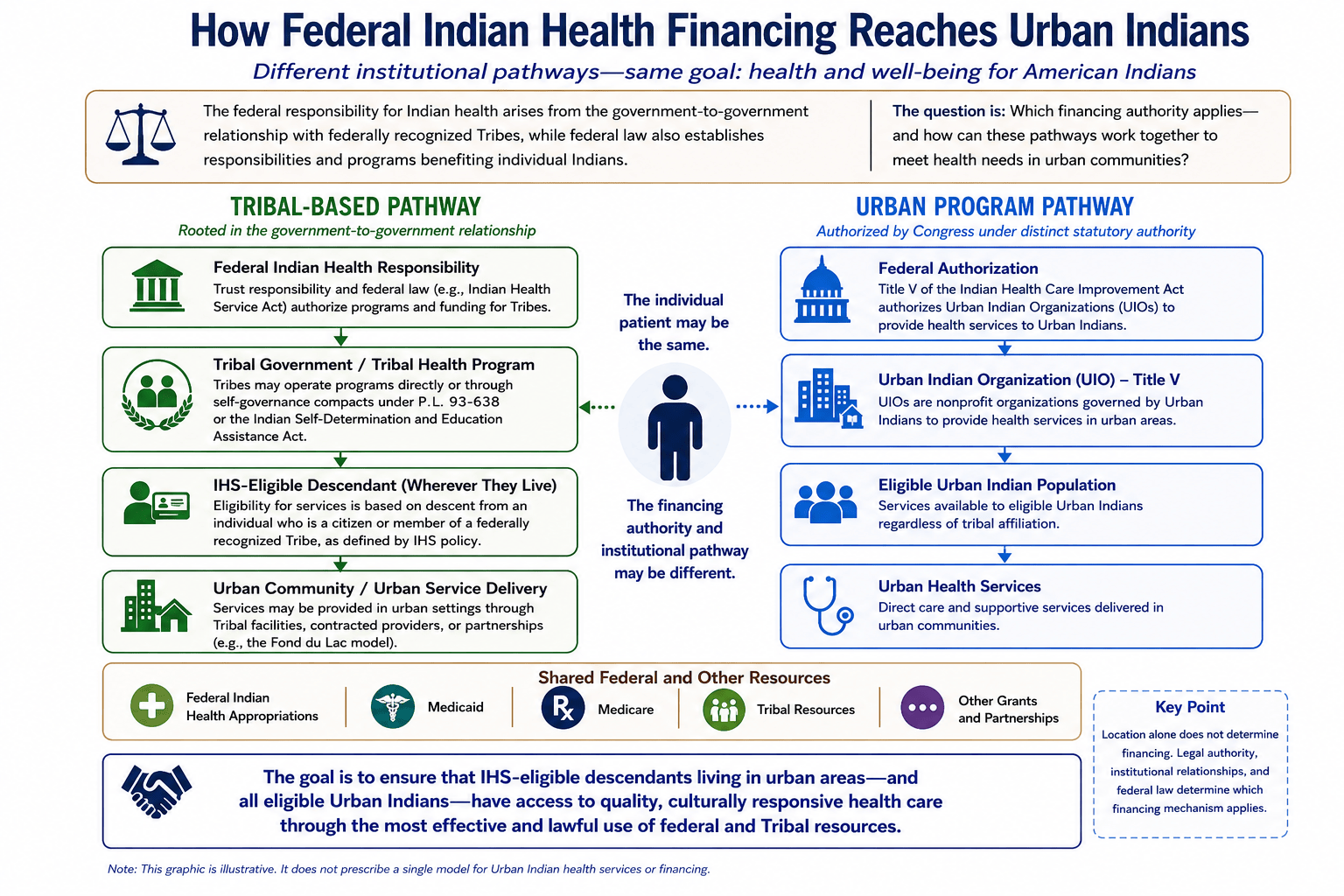
Papers VI–VIII extend the Indian Health Financing Series into the Urban Indian health context. They examine how population measurement, legal authority, Medicaid financing, and federal policy affect AI/AN patients and Urban Indian Organizations.
Federal Indian health financing can reach urban Indians through different institutional pathways. The pathways shown are illustrative and do not prescribe a single model for Urban Indian health services or financing.

Author’s Note
The Urban Indian Health papers extend the Indian Health Financing Series into an area in which my direct experience is more limited than it is with IHS and Tribal health programs.
My professional work included substantial experience with Tribal health financing and policy, including work with the Northwest Portland Area Indian Health Board, the National Indian Health Board, and Tribal health programs. I did not, however, serve as the executive director of an Urban Indian Organization or have the same operational experience with UIO administration that I have with Tribal and IHS health programs.
Accordingly, these papers should be read primarily as Indian health financing and policy analysis applied to the Urban Indian health context, rather than as a definitive account of Urban Indian health program operations.
Where the papers address UIO financing, Medicaid, population measurement, or federal policy, the analysis is intended to identify financing questions and test available evidence. Where conclusions depend on operational characteristics of individual UIOs or urban Indian communities, those conclusions should be regarded as more provisional and open to review by Urban Indian health leaders and other subject-matter experts.
Paper VI
Urban Indian Health Programs and the Indian Health Non-System: A Structural Analysis
This paper examines the position of Urban Indian Organizations within the Indian health system, with particular attention to legal authority, financing, Medicaid reimbursement, eligibility, and federal support. It explores how the distinction between IHS, Tribal, and Urban Indian programs affects the financing available to AI/AN patients in urban settings.
The analysis also examines several situations in which IHS or Tribal programs serve urban populations under the full I/T financing structure. These examples raise a broader question: whether the financing disparity experienced by UIO patients is primarily a geographic difference or instead reflects the legal authority under which health services are provided.
The paper develops a four-type framework for examining urban Indian programs operating under Tribal or IHS authority and considers the implications for Medicaid financing and the federal trust responsibility. The analysis is intended as an application of the Indian health financing framework to the Urban Indian context rather than as a definitive account of UIO operations.
Related graphic: How Medicaid Works Differently in Indian Country
Paper VII
The Cost of Extending 100% FMAP to Urban Indian Organizations: A Program-Level Estimate
This paper develops a program-level estimate of the federal cost of extending 100% Federal Medical Assistance Percentage (FMAP) to Urban Indian Organizations. Using available program-level data from Urban Indian Organizations providing primary care, the analysis estimates the additional federal Medicaid cost associated with applying 100% FMAP to eligible AI/AN patients.
The analysis produces an estimated additional federal cost of approximately $33–59 million annually, depending on the utilization assumption — about $330–590 million over ten years, compared with the Congressional Budget Office estimate of $941 million to $1 billion and the National Council of Urban Indian Health estimate of about $547 million. The paper examines why program-level and top-down approaches produce different results.
The paper also considers the challenge presented by UIOs that serve substantial numbers of non-Indian patients. Rather than assuming that all Medicaid expenditures at such organizations should receive 100% FMAP, the analysis explores a blended-rate approach that distinguishes eligible AI/AN patients from other patients.
Related graphic: How Medicaid Works Differently in Indian Country
For the conceptual distinction between payment rate and financing share that this cost estimate depends on, see the companion piece, “The IHS-OMB Rate and FMAP: An Underappreciated Driver of Indian Health Program Medicaid Financing.”
Paper VIII
What the Infrastructure Study Shows — and What It Cannot: A Review and Critique of the FY2023 Urban Indian Organization Infrastructure Study
This paper reviews the IHS Urban Indian Organization Infrastructure Study, Report to Congress, FY2023, with particular attention to its population methodology. The study provides useful information on UIO staffing, operating budgets, facilities, and patient flows, while its population analysis raises questions about the denominator used to measure the population served.
A central issue examined in the paper is the study’s reported 28% market-capture rate. The analysis considers how the use of an AI/AN-alone population denominator and changes in Census racial-identification methodology affect that estimate.
Using the 2015–2019 ACS 5-year AI/AN alone-or-in-combination population as an alternative denominator, the paper develops a lower estimated market-capture range of approximately 14–16%. The analysis is presented as a methodological review of the study’s population measure and as part of the broader Indian Health Financing Series examination of how population definitions affect estimates of Indian health needs.
Related graphic: Key Definitions of AI/AN Population with Estimates and Administrative Data
Related Case Studies
Supplement I — The Urban–Tribal Connection: Are Urban Indian Health Programs Part of a Tribal Community?
This exploratory case-study paper examines the connections between Urban Indian health programs and specific Tribal communities in Minneapolis, Spokane, Dallas, and Milwaukee. It develops a four-type framework for understanding urban–Tribal relationships and considers what those relationships may imply for financing, data infrastructure, and the federal trust responsibility. The analysis is intended as contextual research supporting the broader financing questions examined in Papers VI and VII.
Supplement II — Sovereign Capacity as a Financing Solution: The Fond du Lac Model
This case study examines the Fond du Lac Band of Lake Superior Chippewa’s Center for American Indian Resources in Duluth, Minnesota, as an example of a Tribal program extending its health and human services capacity into an urban community. The analysis considers how Tribal 638 authority, administrative capacity, and long-term institutional development can affect financing for urban-dispersed Tribal members. The case is presented as an illustration of the broader financing issues examined in Papers VI and VII, rather than as a general model for all Urban Indian programs.