Hank Adams (1943–2020), Assiniboine and Sioux, never called himself a policy analyst. Yet his work, from the fish-ins of the 1960s to his last years, moved through every stage of the policy process, and at each stage he acted on what that stage required. This page traces that pattern in his own words and in the public record. I am a political scientist, with a PhD in political science, and much of my work applies political science methods and constructs to the study of policymaking; this page applies one of them, the policy cycle. I knew Hank only in his last years, and our conversations were about family history, not policy. What follows comes from the documents.
A stage play and a film treatment about Hank Adams are in development.
Read the illustrated booklet: Understanding the Contributions of Hank Adams →
A 28-page exploration of his methods, relationships, and accomplishments through political science.
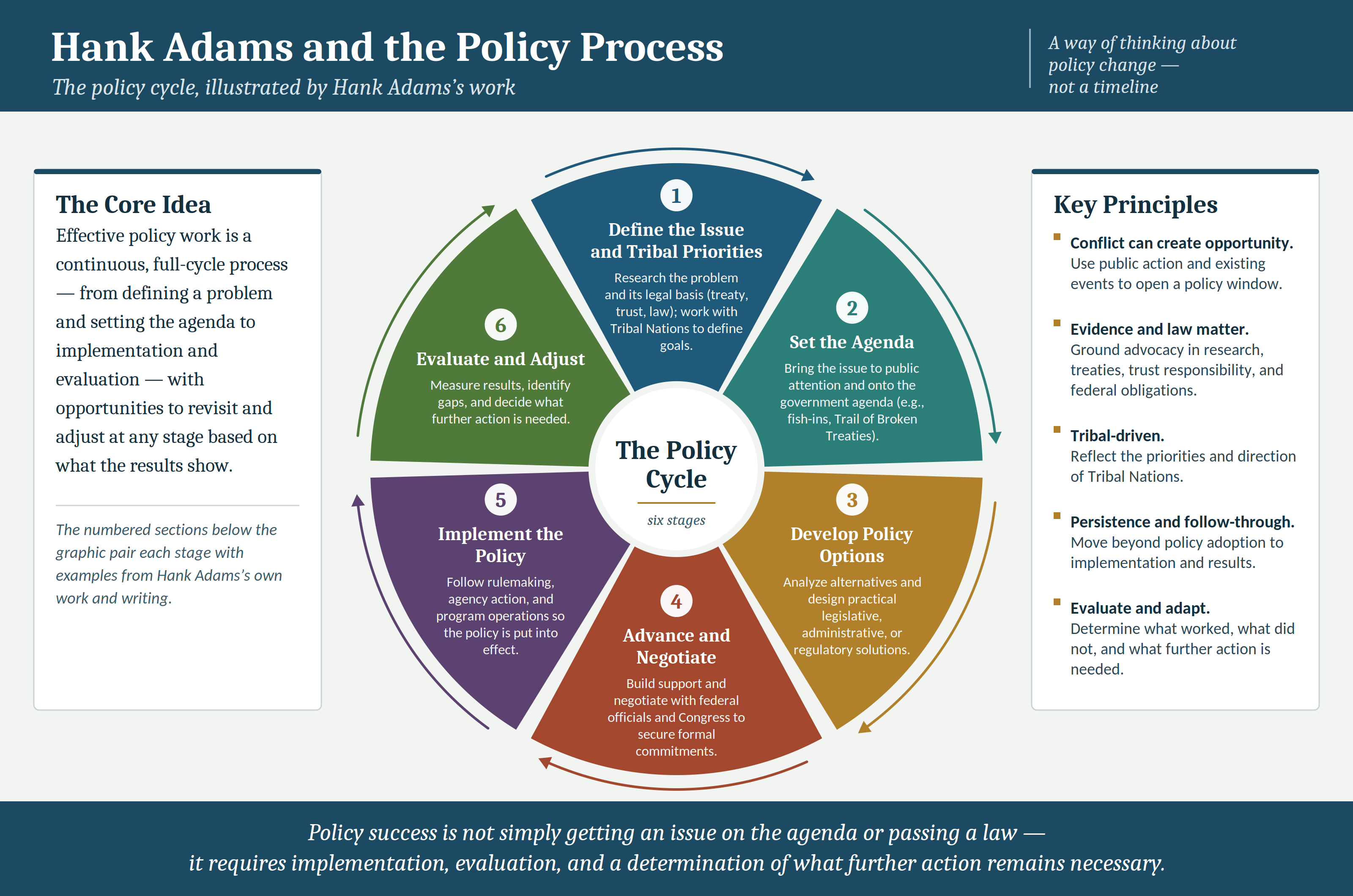
Go to a stage: 1. Define the Issue and Tribal Priorities · 2. Set the Agenda · 3. Develop Policy Options · 4. Advance and Negotiate · 5. Implement the Policy · 6. Evaluate and Adjust
1. Define the Issue and Tribal Priorities
“Some say the problem is…; we say the problem is….”
Washington State said it regulated Indian fishing for conservation. Hank spent years building the record that showed otherwise; the tribes, he later said, proved that “conservation had not been the real issue at all.” When opponents blamed the Boldt decision’s 50-50 split for the fishery’s troubles, he answered before the U.S. Commission on Civil Rights in 1977 with the industry’s own numbers: non-Indian commercial fishing units had grown from fewer than 3,500 in 1962 to more than 6,500. “They split it 50-50, three times in that period. Why not another split?” The Indians, he said, had become “a smokescreen or … a scapegoat to hide the real problems in the commercial fishing industry.”
2. Set the Agenda
“We have to get this on the agenda, and this action will help.”
In 1964 Senators Magnuson and Jackson backed resolutions to put treaty fishing under state regulation or buy out Indian fishing rights altogether. That year the fish-ins began. Hank organized the protest at the State Capitol and brought Marlon Brando to Olympia to fish and risk arrest, moving treaty rights from local to national news. By 1972 he was helping assemble eight Native organizations for the Trail of Broken Treaties, whose Twenty Points even asked that Indian representatives address a joint session of Congress and the nation.
3. Develop Policy Options
“We have Tribal support for our proposal.”
The Twenty Points were not one man’s wish list. Their preface describes them as “a culmination of efforts of the Caravan Workshop” in St. Paul in October 1972, drawing on caravan participants, Indian authors and Tribal leaders; Hank coordinated the recommendations and wrote the final draft. This is what I have called the “invisible signature”: the agreement Tribes build among themselves before any government is asked to sign. One of the points called for a commission to review treaty commitments and violations.
4. Advance and Negotiate
“We will testify to convince Congress.”
Within months that idea was before Congress as S.J. Res. 133, the resolution that created the American Indian Policy Review Commission. In July 1973 Hank testified that the Senate’s version was “substantially better, a great improvement on our proposal of early March.” He gave up that earlier proposal’s provision for some Tribal appointments to the Commission. On one point he held firm: “All congressional appointees, no executive appointees.” The law signed on January 2, 1975 adopted that method.
5. Implement the Policy
“We will be here to see it done right.”
Hank served as lay counsel at the Boldt trial, and after the February 1974 decision he was at the May 1, 1974 meeting where the case tribes founded the Northwest Indian Fisheries Commission. Three years later he told the Civil Rights Commission that some people had spent those years “trying to have it implemented,” against “a more massive effort to make certain that it might never be implemented or ultimately be defeated.” On the same panel, Billy Frank Jr. put the commitment plainly: “I’m an Indian, and I live right here and I will be here.”
6. Evaluate and Adjust
“After a time, we look again at how it is working.”
In 1973 Hank asked Congress for “more concrete definitions of trust relationships and trust responsibilities.” Once the Commission was created, he chaired its Task Force One, on trust responsibility and the federal-Indian relationship, including treaty review: the first full review of federal trust performance since the Meriam Report. Fellow task force members on the Commission included Alan Parker (Chippewa-Cree), on tribal government, and Mel Tonasket (Colville), president of the National Congress of American Indians, on federal administration. Hank kept evaluating for the rest of his life. After the Supreme Court decided Herrera v. Wyoming in 2019, he sent Indian Country Today a 14-page review of treaty hunting and fishing cases. He was 76.
Lessons for today
Hank recognized a victory, but he did not celebrate it as the end of the work. A statute or a court decision is one signature; the rules, guidance, state action and Tribal consensus that make it operate are many more. Indian health financing shows the same pattern. The managed care protections in ARRA Section 5006 took effect by statute in 2009, but plans were not required to comply until 2017. My paper Making Indian Health Financing Policy traces those pathways, and Building Consensus describes the Tribal agreement-building that comes first.
The full evidence. A longer version of this analysis, with the complete excerpts, a comparison of the Twenty Points with the Commission’s Final Report, and source notes, is in the AI Sandbox: Hank Adams and the Policy Process: The Evidence, Stage by Stage (PDF). It was written with AI from sources I selected and supplied, and carries the IHF-AI mark.
Sources
- U.S. Senate, Subcommittee on Indian Affairs, Establishment of the American Indian Policy Review Commission, hearings on S.J. Res. 133, July 19–20, 1973.
- Trail of Broken Treaties, Twenty Points (1972), final draft by Hank Adams.
- American Indian Policy Review Commission, Final Report, Vol. 1 (1977).
- American Indian Policy Review Commission, Final Report, Vol. 2 (1977), “Brief Profiles of the Task Force Members,” p. 11 (ERIC ED190335), listing Hank Adams as Chairman of Task Force 1: Trust Responsibility and Federal/Indian Relationship, Including Treaty Review.
- U.S. Commission on Civil Rights, American Indian Issues in the State of Washington, hearing, Seattle, October 19–20, 1977, Vol. I, pp. 236–255.
- Associated Press obituary, December 2020; Legacy Washington, Hank Adams biography; Indian Country Today (2006).
Hank Adams: Related Papers and Graphics →
Explore the policy-cycle and leadership graphics, related papers, case studies, and source records together.