This page holds papers produced mostly by AI tools. I post them so readers can see what these tools do with Indian health finance questions: where they help, and where they go wrong. They are not part of the Indian Health Finance series and should not be cited as my work. When I have reviewed a paper, my comments appear under it as Author’s analysis.
How to read these materials: AI-generated work can sound coherent while making unsupported extrapolations, inventing or misrepresenting sources, or smoothing over gaps in the evidence. I use project-specific instructions to limit these risks, but they cannot eliminate them. Each entry identifies its sources, the AI’s role, and its review status. See the full AI-assisted scholarship process and safeguards.
Papers marked with the  IHF-AI badge (Indian Health Finance, AI-written) were written by AI, and the badge appears on every page of the paper itself. Review status is one of three: not yet reviewed; directed and partly reviewed (I set the question and sources and checked parts of the result); or reviewed (my Author’s analysis follows the entry). My own work is on the Publications and Related Papers pages.
Contents
- Financing and Budget: IHS Operating Funding, FY2021–FY2025, Excluding Facilities and Health IT
- Population and Data: IHS Population Metrics · IHS Access and Health Coverage · Who Can Be Billed, and Who Could Be Enrolled · What Medicaid Data Cannot Yet Tell Indian Health Programs
- Policy History: Hank Adams and the Policy Process · Hank Adams on Dramatizing Wounded Knee · The AIPRC Final Report (1977) and Indian Health
- Analyst Training: A Primer for New Tribal Health Policy Analysts
Financing and Budget
IHS Operating Funding, FY2021–FY2025: A Parallel Analysis Excluding Facilities and Health IT
AI-generated working paper · Question and exclusions set by me; figures from IHS operating plans and Congressional Justifications · October 2026, revised October 27 · Author review: not yet reviewed
This AI-written working paper is a companion to my IHS Budget FY2021–FY2025: Five-Year Analysis and Section 105(l) Research. It removes the Indian Health Facilities account and all health information technology funding (the Electronic Health Record System line and the Health Information Technology amount) from the denominator in every year, leaving the budget that runs health programs year to year. On that basis, IHS operating funding rose 13.8 percent from FY2021 to FY2025, compared with 11.9 percent for the full program level, and annual growth fell from about 4 to 5 percent in FY2022 and FY2023 to 3.1 percent in FY2024 and 0.8 percent in FY2025. Purchased/Referred Care plus CHEF lost share of the operating budget in every year, and two-thirds of FY2024 growth went to Contract Support Costs and Section 105(l) leases. The paper also shows that more than half of the Health Services share gain in the five-year review is EHR modernization. A few FY2025 line amounts are derived or assumed and are flagged in the paper.
Graphics for this topic. These two graphics are my own design (not AI-written, but AI executed) and also appear as Graphic 18. They extend the period through the FY 2027 request and show discretionary budget authority, so SDPI is not included and the totals will not match the paper’s program-level figures exactly.

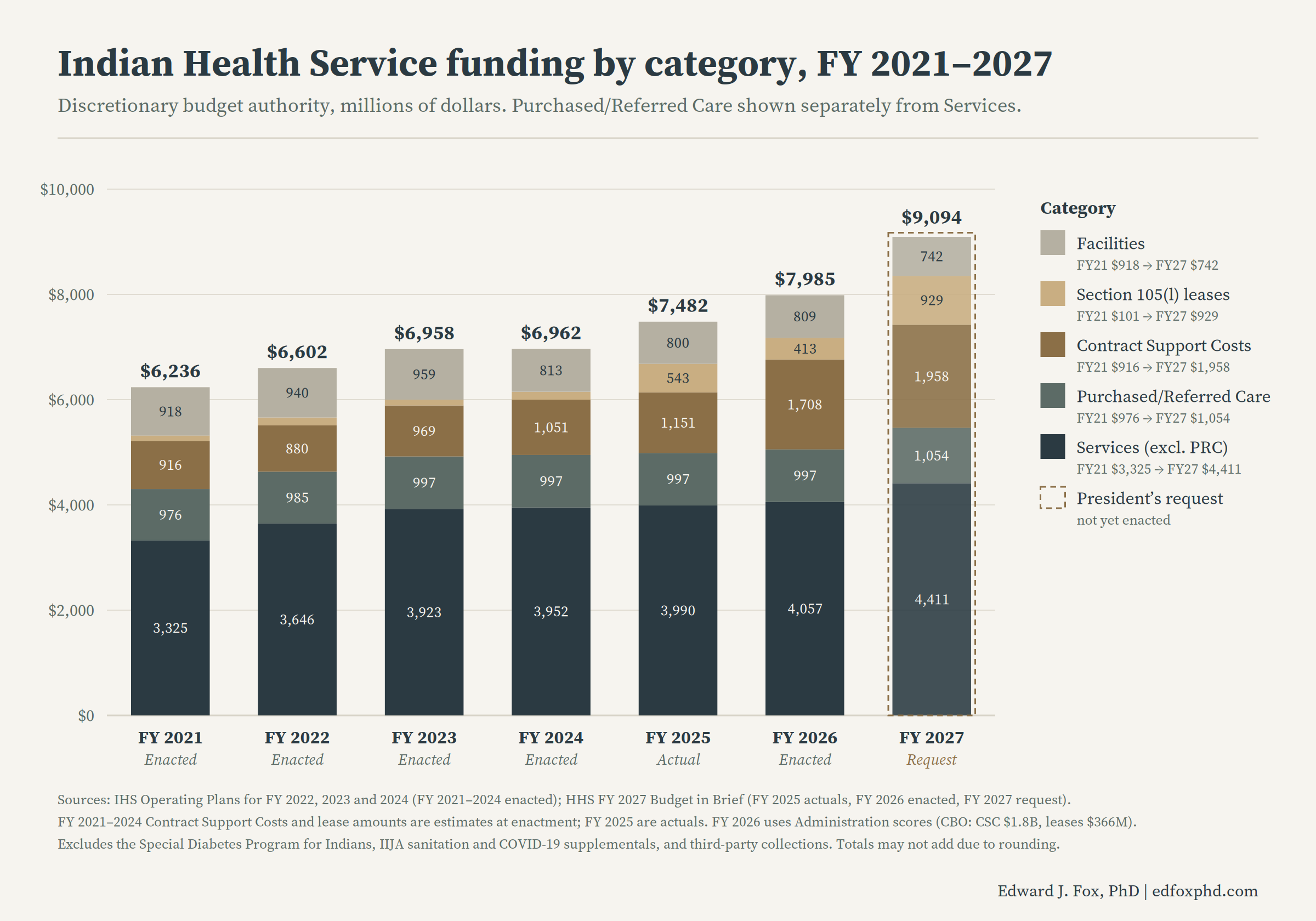

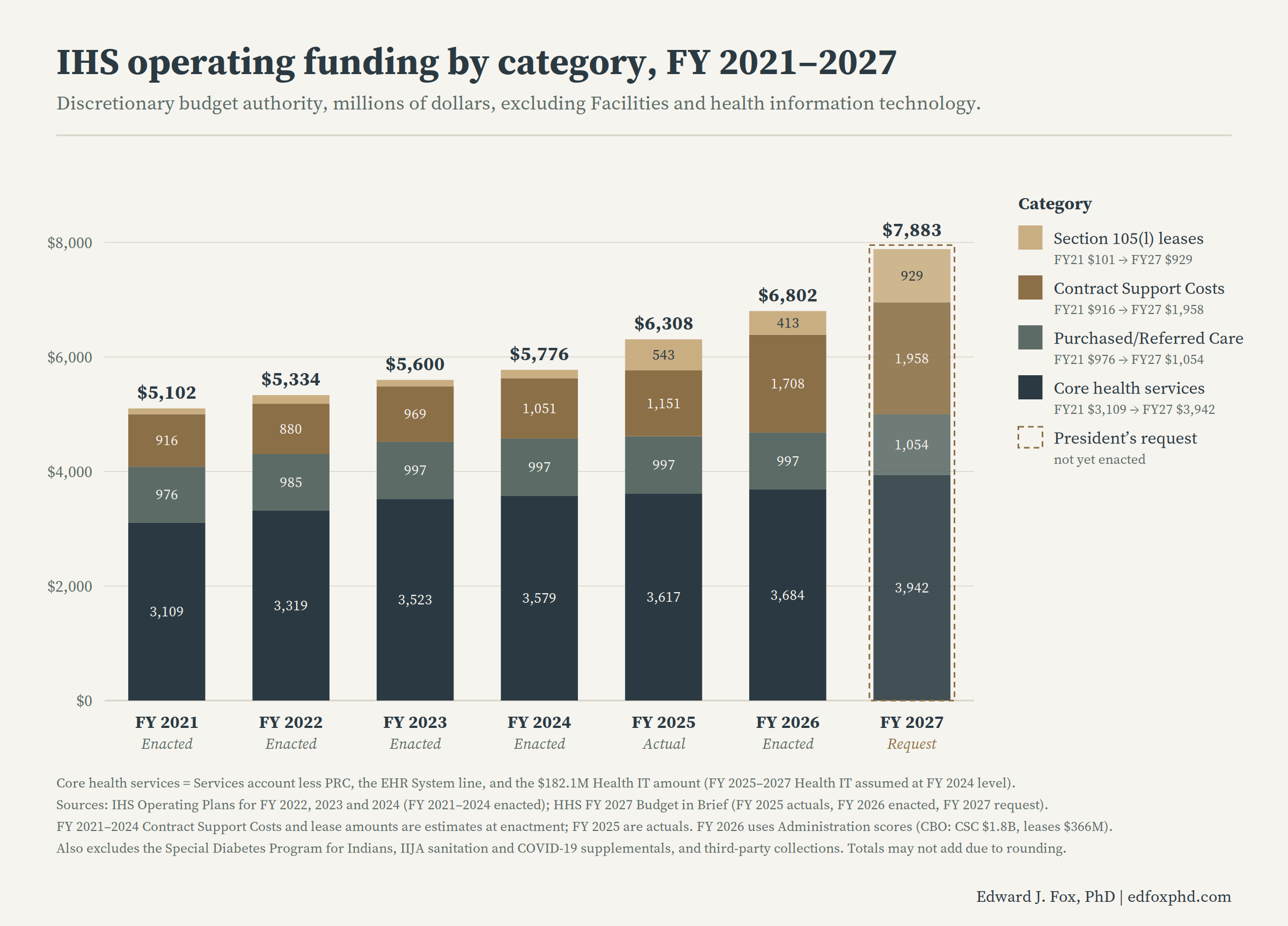
Start with: IHS Budget Basics. Read alongside: IHS Budget FY2021–FY2025: Five-Year Analysis · IHS Budget Tables, FY2021–FY2025 · Graphics 17A–17D · Graphics 18A–18B
Population and Data
Data Pipeline Flowchart: How the ACS Tables Behind These Papers Were Built
AI-generated graphic · Drawn from my ACS PUMS workflow and the papers and data tables on this site · November 2026, revised November 12 · Author review: not yet reviewed
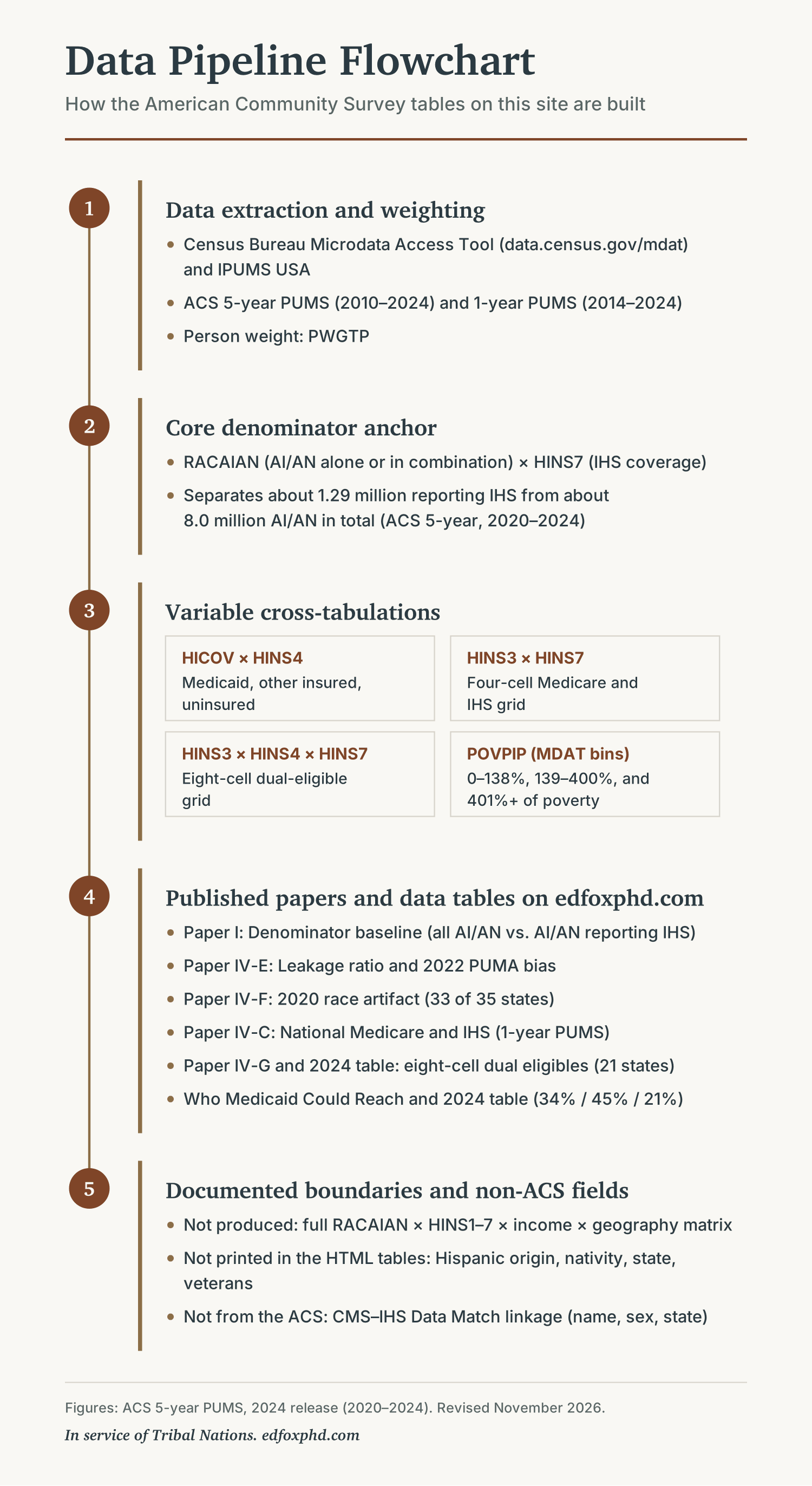
This graphic traces the American Community Survey work behind the Population and Data papers, in five steps. It starts with extraction from the Census Bureau Microdata Access Tool and IPUMS USA (5-year PUMS 2010–2024 and 1-year PUMS 2014–2024, weighted with PWGTP). It then anchors every denominator to AI/AN people, alone or in combination, who report IHS coverage (RACAIAN × HINS7): about 1.29 million of about 8.0 million AI/AN in total in the 2020–2024 ACS 5-year data. Next come the cross-tabulations for Medicaid and other coverage, the Medicare and IHS grid, the eight-cell dual-eligible grid, and income relative to poverty, followed by the papers and tables built from them. The last step names what the pipeline does not produce, including the full race × coverage × income × geography matrix, and the CMS–IHS Data Match linkage, which comes from administrative files rather than the ACS.
Read alongside: ACS Data Tables · Graphic 19 · Related Papers
IHS Population Metrics: Service Population, Registrants, and Users
AI-generated research package · IHS user population tables, FY2021–FY2025, and Paper I · October 2026 · Author review: not yet reviewed
This AI-written report argues that the Indian Health Service has no single population count. The Census-based service population, the registrant count in IHS’s national patient registration system, and the three-year user population each answer a different question, and treating them as interchangeable is the most common error in IHS population research. Using the IHS user population tables for FY2021–FY2025, it finds that users fell from about 62% to 55% of the projected service population nationally (the FY2025 figure uses a shorter encounter window, so it carries a caveat); that the ratio runs from 21% in California to 113% in Alaska; and that registrants exceed the Census-based projection in seven of twelve Areas. Because user counts drive IHS formula funding more than any other variable, these differences shape how new money is divided. Two appendices compare the report with Paper I, How We Count Matters, including points where the AI disagrees with or corrects that paper.
Read alongside: Paper I — How We Count Matters · Paper V — The Full-Funding Requirement · Graphic 2 — How We Count AI/AN Population · Graphic 2A — IHS Active User Population, FY 2017–2025 · Paper IV-F — AI/AN Health Coverage Trends
IHS Access and Health Coverage Among American Indians and Alaska Natives: An ACS-Based Analysis
AI-generated essay · Limited to edfoxphd.com content; no outside sources · October 2026 · Author review: not yet reviewed
This AI-written essay examines what the American Community Survey can and cannot tell us about American Indians and Alaska Natives who report Indian Health Service coverage. It distinguishes self-reported IHS access from health insurance coverage, administrative registration, actual service use, and health outcomes, and explains why population denominators and the 2020 Census race-question change matter when interpreting trends.
Read alongside: Paper IV-F · Paper IV-G · ACS Data Tables
Who Can Be Billed, and Who Could Be Enrolled: Medicaid and Medicare among American Indian and Alaska Native People with Access to IHS
Drafted with assistance from Claude (Anthropic) · My questions, ACS 1-year and 5-year PUMS extracts I prepared, and my earlier papers · November 2026, revised November 9 · Author review: reviewed; questions, analysis choices and conclusions are mine · Also listed on Related Papers
This paper uses the American Community Survey to show how many American Indian and Alaska Native people reporting access to IHS have a payer an IHS-funded program can bill, comparing 2015–2019 with 2020–2024. In 2024, 47 percent had Medicaid, Medicare or both, up from 42 percent in 2019, with wide differences by state. About 167,000 people reporting access to IHS have incomes under 139 percent of poverty and no Medicaid, down from about 223,000 in 2015–2019; Oklahoma, Arizona, New Mexico and South Dakota account for 64 percent of them. Medicaid coverage rose in every income band and in every group of states, whenever they expanded, so the comparison does not yet isolate an effect of the late expansions; the continuous-enrollment years of 2020–2023 likely account for much of the rise. The paper explains what “access to IHS” does and does not mean, and sets out how the comparison can be repeated with the 2024–2028 ACS release.
Read alongside: What Medicaid Data Cannot Yet Tell Indian Health Programs (companion) · IHS Access and Health Coverage · Paper IV-G · Related Papers · ACS Data Tables
What Medicaid Data Cannot Yet Tell Indian Health Programs: Access to IHS, the CMS–IHS Medicaid Data Match, and a Proposal for the Next Match
Drafted with assistance from Claude (Anthropic) · My questions, earlier draft and ACS extracts, and the NIHB CMS–IHS Data Match Report (October 2025) · November 2026, revised November 9 · Author review: reviewed; questions, analysis choices and conclusions are mine · Also listed on Related Papers
This companion paper argues that published data cannot tell Tribal leaders who receives care at an IHS-funded program while enrolled in Medicaid, or how much Medicaid pays those programs. It asks why fewer American Indian and Alaska Native people report access to IHS: the 8 percent decline between 2015–2019 and 2020–2024 is not explained by the 2020 race question change and came entirely in the lower income bands, and the paper concludes that we don’t know why. It examines adults with and without children, shows that matched Medicaid enrollment (784,540 in 2019 to 878,439 in 2023 across 27 states) reflects continuous enrollment as well as expansion, and asks whether the match can help explain the ACS decline. It proposes five design steps for the next match that would follow patients from enrollment to visits to payment, using the IHS workload definition, and notes how few programs submit workload data. A closing section weighs the risk that a national Medicaid payment total could be used against appropriations, and leaves open whether the proposed changes are worth their effort and risks—a question for Tribal leaders.
Read alongside: Who Can Be Billed, and Who Could Be Enrolled (companion) · Paper IV-F · Related Papers · ACS Data Tables
Policy History
Hank Adams and the Policy Process: The Evidence, Stage by Stage
AI-generated paper · Sources I selected and supplied · October 2026 · Author review: directed and partly reviewed
This AI-written paper sets out the full evidence behind my page Hank Adams and the Policy Process. It follows Hank Adams through the six stages of the policy process (problem definition, agenda setting, proposed solutions, enactment, implementation and evaluation) and gives, for each, excerpts from his July 1973 Senate testimony, the Twenty Points (1972), the American Indian Policy Review Commission’s Final Report (1977), and his October 1977 testimony before the U.S. Commission on Civil Rights. It includes a table comparing proposals in the Twenty Points with recommendations in the Final Report. Points drawn from my own AIPRC papers are marked in the text.
Read alongside: Hank Adams and the Policy Process · Making Indian Health Financing Policy · The AIPRC Final Report (1977) and Indian Health
Hank Adams on Dramatizing Wounded Knee: His 1974 Letter and the Stage Play
AI-generated summary · Hank Adams’s letter of July 17, 1974, which I supplied · November 2026 · Author review: not yet reviewed
This AI-written summary examines Hank Adams’s letter to Columbia Pictures, Abby Mann, and Marlon Brando about Mann’s treatment for a Wounded Knee film. Adams wanted the film made but held it to a higher standard. Invention should not be presented as history, especially about living Indian people. Self-serving accounts should not become the story. And the Indian opposition, the goon squads and others on the other side, deserved a viewpoint and a chance at redemption. The letter has been adopted as the working conscience for my proposed stage play Hank Adams. The paper’s final section shows how it shaped the script, including the Tribal chairman and Pine Ridge resident added in Revision 7.
Read alongside: Hank Adams and the Policy Process · Hank Adams: The Evidence, Stage by Stage · Stage Play Source Notes (PDF)
The AIPRC Final Report (1977) and Indian Health
AI-generated working paper · AIPRC Final Report, S. 2526 bill text, and my Title IV account · October 2026 · Author review: not yet reviewed
This AI-written working paper traces how the 1977 Final Report of the American Indian Policy Review Commission anticipated Tribal self-governance and the 1999–2000 Indian Health Care Improvement Act reauthorization draft. It reviews the Commission’s self-determination framework, its assessment of Indian health (health status, contract care, budget allocation, Indian involvement, and alternate resources), and its health recommendations, then matches those findings to provisions of S. 2526 (106th Congress) in a concordance table. Each point is tagged by source: the Final Report, the bill text, my own account of the Title IV drafting, or other sources. The paper ends with a list of items still to be verified.
Read alongside: IHCIA Reauthorization: History and Participants · Making Indian Health Financing Policy
Analyst Training
A Primer for New Tribal Health Policy Analysts: What You Need to Know, and How to Find Out
AI-generated primer · Drawn from edfoxphd.com papers, graphics, and pages, at my request · November 2026 · Author review: not yet reviewed
This AI-written primer is for policy analysts newly hired by a Federally Recognized Tribe or a regional or national Tribal organization. It argues that an analyst’s first job is to make sure Tribal leaders walk into every meeting with facts and figures that are current, correct, and their own. It covers what a new analyst needs to know (the legal foundations of Indian health, how the money moves through IHS appropriations, Medicaid, and Medicare, who is served and how they are counted, whether funding is adequate, and how policy gets made) and how to find out: a source guide, a calendar of when key figures update, working habits for briefing leaders, a first-month reading path through this site, and a glossary. It does not cover state or national legislative politics. A few general background items not taken from this site are marked for verification in the text.
Read alongside: Research Map · Indian Health Finance course · Resources · Using This Site for Grant Proposals